Blog

Scale Calibration for Food Manufacturers: Staying Compliant and Audit-Ready

Why Weighing Accuracy is Non-Negotiable in Food Production

<p>
In most industries, a scale that drifts slightly out of tolerance is an inconvenience. In food manufacturing, it can mean selling underweight products, triggering a Trading Standards investigation, failing a BRC audit, or in worst-case scenarios, initiating a product recall that costs far more than any calibration programme ever would.
</p>
<p>
Food manufacturers operate under a uniquely demanding set of pressures. Customers expect consistency. Retailers demand compliance documentation.
</p>

Regulators inspect without warning. And with margins already tight across much of the sector, any source of waste, including overfilling products to compensate for inaccurate scales, eats directly into profitability.

Calibration is the foundation that holds all of this together. Yet it remains one of the most commonly overlooked maintenance priorities in food production, often treated as an annual checkbox rather than the ongoing quality control measure it actually is.

The Regulations Food Manufacturers Must Meet

If you produce or package food commercially in the UK, your weighing equipment is subject to a range of regulatory and certification requirements. The most relevant are:

BRC Global Standard for Food Safety

The BRC standard, now in its ninth iteration, is the dominant certification framework for food manufacturers supplying major UK retailers. It requires that all measuring and monitoring equipment, including scales, be calibrated at defined intervals and that records be maintained to demonstrate traceability. Auditors will ask to see your calibration certificates. If you can't produce them, or if they're out of date, you risk a non-conformance that could jeopardise your certification entirely.

SALSA (Safe and Local Supplier Approval)

For smaller food producers supplying local or regional buyers, SALSA certification serves a similar function to BRC. It includes equivalent requirements around equipment calibration and record-keeping, and auditors take the same approach: they expect to see documentation, not just a verbal assurance that scales are accurate.

HACCP (Hazard Analysis and Critical Control Points)

HACCP is a systematic approach to food safety that requires businesses to identify and control hazards at every critical point in their production process. For many food manufacturers, weighing is a critical control point, particularly where portion control, ingredient ratios, or allergen management are involved. A scale that reads inaccurately at a CCP isn't just a compliance failure; it's a food safety risk.

UK Weights and Measures legislation

If your products are sold by weight, which covers the vast majority of packaged food, you are legally required under the Weights and Measures Act and the Packers' Rules to ensure your average quantity declarations are accurate. Trading Standards inspectors carry out checks, and businesses found to be consistently underselling or misdeclaring quantities can face prosecution.

The Real Cost of Inaccurate Scales in Food Production

The consequences of running uncalibrated or out-of-tolerance scales in a food manufacturing environment are rarely limited to a single problem. They tend to compound.

Consider a manufacturer producing 10,000 units per day of a product declared at 500g. If their floor scale is reading 3g light, a drift that would be invisible without calibration, they are giving away 30kg of product every single day. Over a year, that's nearly 11 tonnes of product shipped without payment. At even a modest commodity cost, the financial loss dwarfs any conceivable calibration budget many times over.

Now add the compliance dimension. If that same drift is identified during a Trading Standards inspection or a BRC audit, the manufacturer faces not just a corrective action but potential certification suspension, retailer delisting, and reputational damage that is far harder to quantify, and far harder to recover from.

Inaccurate allergen weighing carries even higher stakes. A scale that under-reads during the weighing of an allergen ingredient could result in a product that contains more of that ingredient than declared on the label, a serious food safety issue with potential for harm to consumers and significant legal liability for the producer.

What a Proper Calibration Certificate Covers, and What Auditors Look For

Not all calibration certificates are equal, and food manufacturers should understand what a robust certificate actually contains — because an auditor will.

A compliant calibration certificate should include:

  • The identity and unique serial number of the equipment calibrated
  • The date of calibration and the date the next calibration is due
  • The reference weights used, including their traceability to national or international standards (UKAS-traceable weights are the benchmark in the UK)
  • The results of the calibration — including the actual readings recorded at each test point, not just a pass/fail stamp
  • The identity and signature of the engineer who performed the calibration
  • Whether any adjustments were made, and if so, the before-and-after readings

Certificates that simply state "calibrated and passed" without underlying data are increasingly being challenged by BRC and SALSA auditors. If your current provider isn't supplying full-data certificates, it's worth reviewing whether their documentation will hold up under scrutiny.

How Often Should Food Manufacturers Calibrate?

The honest answer is: more often than most businesses currently do, and more strategically than a flat annual schedule allows.

Annual calibration is the minimum baseline for most food manufacturing environments, and it satisfies the basic requirements of BRC and SALSA certification. But it is not always sufficient on its own. A number of factors should inform a more tailored calibration frequency:

Usage intensity. A floor scale used continuously across three production shifts accumulates wear far faster than one used twice a week. High-frequency equipment should be calibrated more often, typically every six months for heavily used units.

Environmental conditions. Scales operating in cold stores, near industrial washdown equipment, or in high-vibration environments are subject to conditions that accelerate drift. These should be checked more frequently and monitored for signs of damage between scheduled visits.

Regulatory environment. Some food manufacturing certifications or retailer codes of practice specify calibration frequencies directly. Always check your specific certification requirements rather than defaulting to a generic annual schedule.

After any significant event. A scale that has been dropped, moved, subjected to a power surge, or repaired should be recalibrated before it returns to service, regardless of when it was last on the scheduled programme.

A good calibration partner will help you build a frequency schedule that reflects how your equipment is actually used, rather than applying a one-size-fits-all annual visit across your entire fleet.

Setting Up a Calibration Maintenance Contract: What to Expect

For food manufacturers with multiple scales across a production site, managing calibration schedules in-house is both time-consuming and easy to let slip. A managed service contract removes that responsibility entirely.

With Oakleyweigh's service contracts for food manufacturers, here's what a typical arrangement looks like:

Your full inventory of weighing equipment is recorded in a maintained asset register — every scale, balance, and weighing system on site, with its location, model, serial number, and calibration history. You don't need to keep track of what needs doing or when; we manage that on your behalf and contact you in advance to schedule each visit at a time that suits your production calendar.

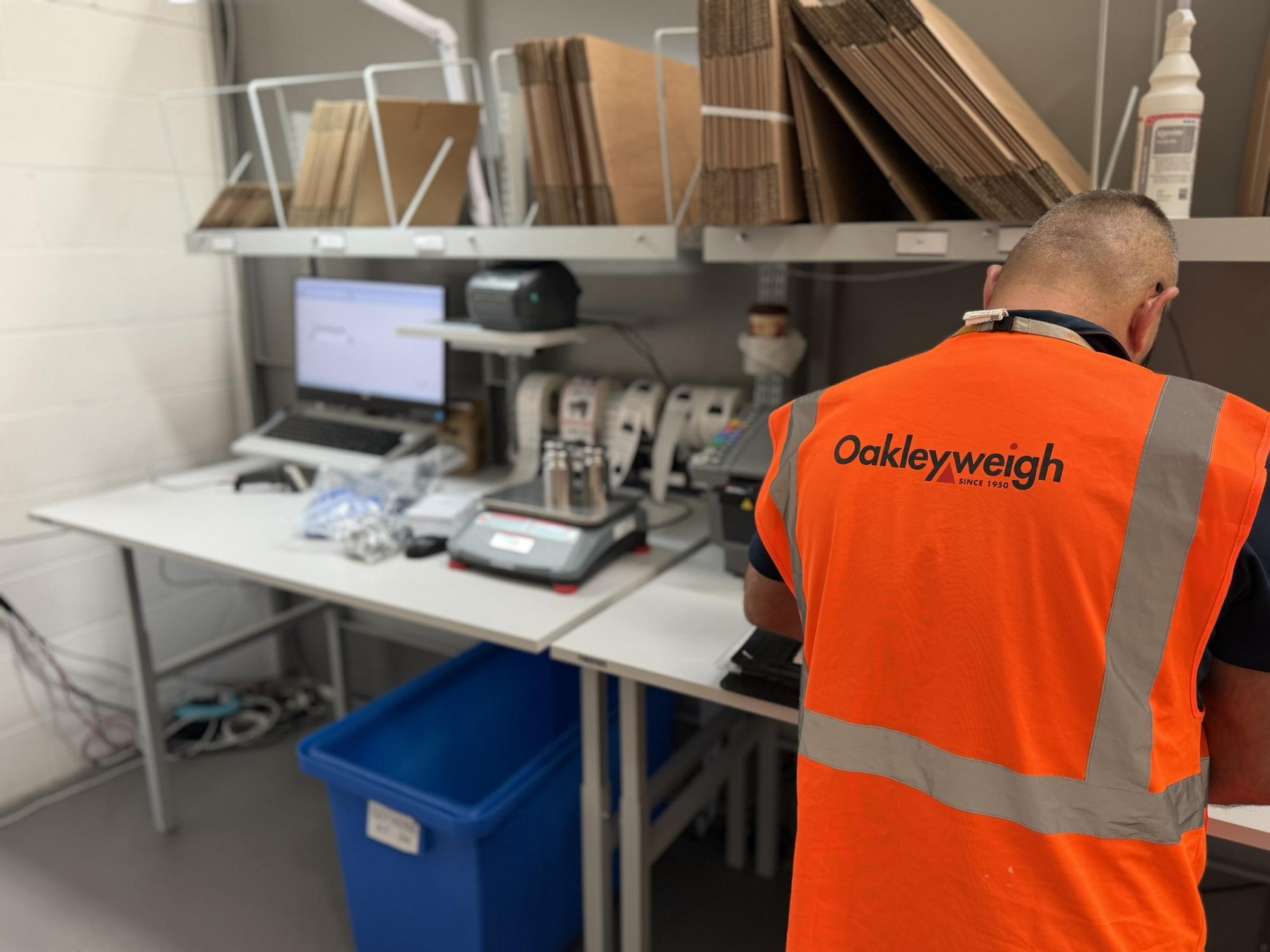
On each visit, our engineers carry UKAS-traceable reference weights and calibrate your full schedule of equipment in a single, planned visit — minimising disruption to your production operations. Where drift or adjustment is required, it's handled during the same visit. Digital certificates are issued immediately, formatted to meet BRC, SALSA, and HACCP audit requirements.

Between visits, you have access to breakdown cover — including same-day call-out for urgent failures — and telephone support for one-off queries about your equipment.

The result is a calibration programme that runs in the background, requires nothing from your quality team beyond a brief annual visit, and produces the documentation trail your auditors expect to see.

Oakleyweigh: Supporting UK Food Manufacturers

Oakleyweigh has worked with food manufacturers across the UK for over 75 years, providing on-site calibration services backed by ISO 9001:2015 accreditation and full UK Weighing Federation (UKWF) membership. Our engineers understand the pressures of food production environments, the audit cycles, the retailer requirements, the need for minimal downtime, and our service is built around them.

Whether you operate a single-site bakery, a multi-line contract packing facility, or a large-scale food processing operation, we can put a calibration programme in place that keeps your scales accurate, your documentation audit-ready, and your quality team focused on production rather than paperwork.

Don't leave your next compliance audit to chance

Contact Oakleyweigh today to discuss your site's requirements, arrange an on-site evaluation, or set up a reliable calibration maintenance contract.

Contact Us
whatsapp
Back To Top